
Real Time Monitoring & Blocking
Real Time Monitoring and Blocking helps you detect and block fraud in real time as an easy, no-code solution. Once enabled, Real Time Monitoring & Blocking (RTM) monitors every transaction as it happens, helping stop fraud attempts while keeping payments smooth for your customers.
RTM is built directly into the TabaPay platform, giving you strong protection without the cost or complexity of separate systems.
TabaPay also offers the most accurate and secure card-level controls in the industry. Our technology links every version of a card across tokens, wallets, and reissues so your rules stay consistent and reliable. This is powered by Payment Account Reference (PAR), a network-standard identifier that provides full card-level visibility without exposing sensitive data.
Request to enable at TabaPay Support or [email protected].
Use Cases
- Identify Elevated-Risk Transactions: Use behavior and transaction signals to flag transactions that look unusual and are commonly associated with fraud or future fraud chargebacks.
- Detect Abnormal Account Funding Behavior Monitor card usage, transaction velocity, and funding patterns to identify abnormal activity. For example, risky behavior could be rapid funding followed by immediate withdrawals, which is often a sign of account misuse.
- Spot Early Warning for Card Testing and Low-dollar Fraud: Identify patterns consistent with card testing, brute-force attempts, or low-dollar transactions designed to blend into normal traffic over time.
- Leverage risk signals from tens of millions of cards and >2MM daily transactions to expand detection and mitigation. If a card is new to you, we have likely seen it before and can help stop fraud before it starts.
- Use PAR for precise and secure card-level controls to ensure unique identification without exposing sensitive data.
- Use templatized rules based on velocities and limits so you can operate within your risk tolerances.
- Fast and seamless integration captures data in days, not months.
- Designed to scale with you as we grow together.
How Client Use RTM Risk Signals
- Gain visibility into transaction behavior that may indicate elevated fraud risk
- Identify unusual funding and usage patterns that deviate from expected customer activity
- Detect and disrupt potential card testing and incremental fraud activity early
How RTM Works
TabaPay provides multiple layers of protection that combine your business knowledge with the strength of TabaPay’s fraud intelligence network.
Sources of Data
The RTM layered system protects against fraud at three levels, each powered by different sources of data:
- Client Proprietary Data: You configure protection based on your own knowledge. This includes unique, non-payment data such as internal customer risk scores, loyalty status, or user IDs that help inform transaction decisions.
- Client Transactional Data: TabaPay analyzes your transaction data to identify risk patterns unique to your business.
- TabaPay Global Intelligence (Coming Soon): Our global network insights leverage data patterns observed across millions of transactions to detect and stop fraud before it reaches you.
RTM Data Flow
RTM works seamlessly within the TabaPay platform and does not require any additional API calls. Once you enable RTM, transaction data automatically flows into TabaPay’s built-in real-time system, which makes block or flag decisions instantly without adding latency.
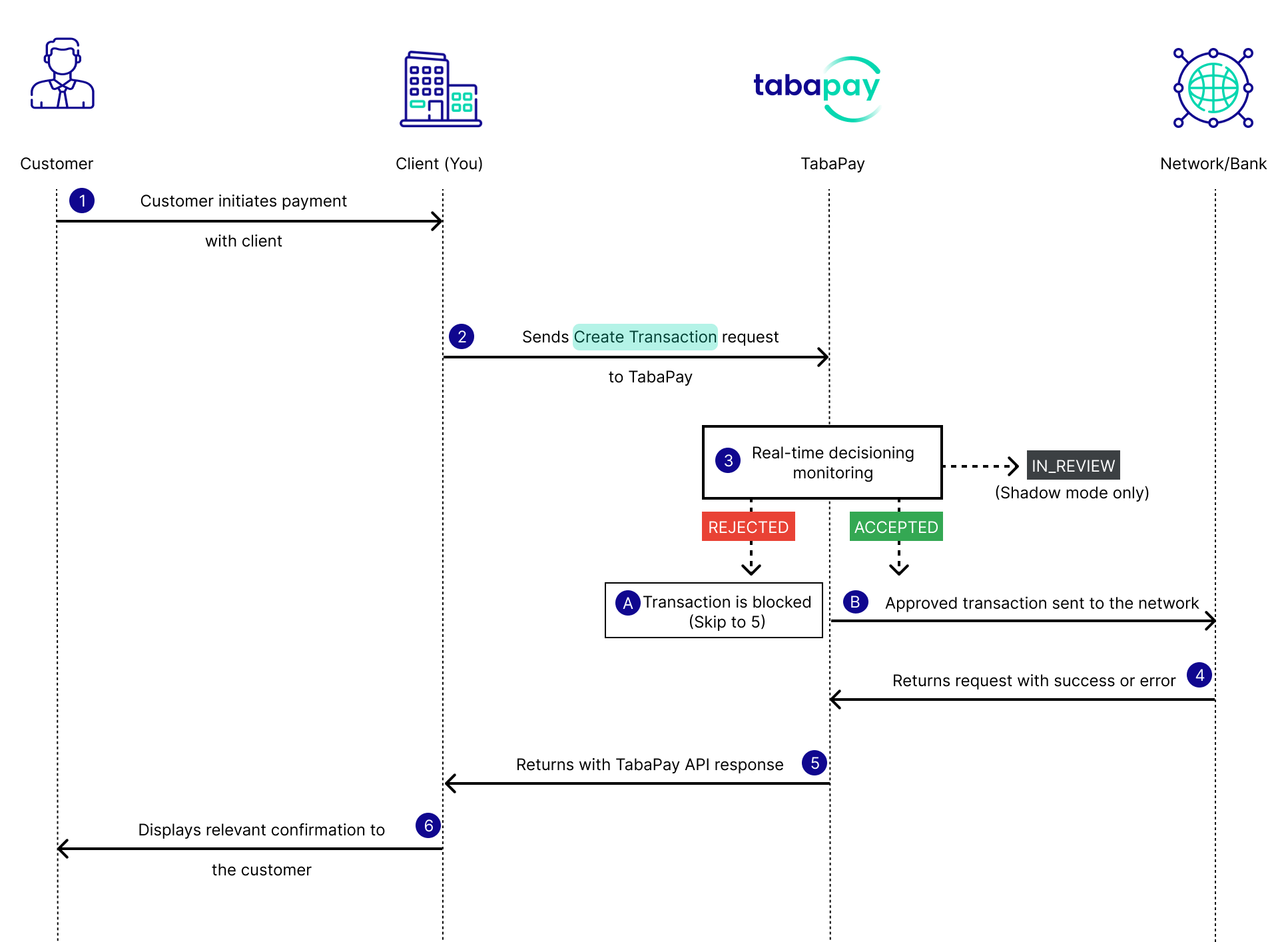
- Customer initiates a payment.
- You send a Create Transaction API request to TabaPay.
- Real-time decisioning and monitoring: ACCEPTED, REJECTED, or IN_REVIEW (shadow mode only)
- If Rejected Transaction is blocked. If Accepted, transaction is sent to the network.
- Network returns with a network success, or error.
- TabaPay returns the API response.
- You display the relevant confirmation to the customer.
Optionally, you can include your proprietary data (such as internal customer risk scores, loyalty status, or user IDs) in the Create Transaction API. RTM will use this information to apply your configured rules and make more informed and precise decisions.
Out-of-the-Box Rules
TabaPay provides ready-to-use rules that you can enable and configure directly. Use the following table to understand which rules you can control, the data they rely on, and how they protect you.
Configurable Controls
You configure the risk controls based on your business knowledge, transaction patterns, and risk tolerance.
| Rule Name | Rule Logic | Client Control | Action | Example |
|---|---|---|---|---|
| Card Velocity | Block/flag transactions when a card exceeds an allowed number of transactions within a set timeframe. | Define number and time window (1/3/7/30 days). | Block/Flag | Block if > 3 pushes in 1 day |
| Card Limit | Block/flag transactions when a card exceeds a set daily or weekly total amount. | Set total amount and time window (1/3/7/30 days). | Block/Flag | Block if total daily pulls > $1,000 |
| Per-Transaction Limit | Block/flag any single transaction above a defined amount. | Define per-transaction maximum. | Block/Flag | Block if amount > $3,000 |
| Card List | Block/flag transactions from cards in the uploaded list. | Upload or edit list of cards (PARs). | Block/Flag | Block Card (PAR) 1xd23kxkans32903 |
| BIN List | Block/flag transactions from BINs in the uploaded list. | Upload or edit list of BINs. | Block/Flag | Block BIN 123456 |
| Velocity, limits based on your data. | Block or flag transactions based on velocity, limit, or list rules, but use your own proprietary data (such as user ID, device ID, etc.). | Upload custom propriety list of cards, BINs, etc.. | Block/Flag | Block if a client user ID has > 3 pushes in 1 day |
Client Intelligence Rules
Rules powered by TabaPay’s analytics on your own transaction data, identifying risk patterns within your ecosystem.
| Rule Name | Rule Trigger | Client Control | Action | Example |
|---|---|---|---|---|
| Excessive Retries | Block/flag transactions from cards that repeatedly fail or are declined and the number of retries exceeds network requirements. | Toggle on/off | Block/Flag | Block if card has more than 10 declines with MasterCard within a calendar day. |
| Same Card, Multiple Names | Block/flag transactions from cards used under multiple customer names within a set period. | Adjust name threshold | Block/Flag | Flag/Black if card used by 2 names in 30 days |
More details about excessive retries rules: Excessive Retry Rules.
Global Intelligence Rules
(Coming Soon)
The most powerful layer: powered by TabaPay’s global network data across all merchants. These rules block known fraud before it reaches you.
| Rule Name | Rule Trigger | Client Control | Action | Example |
|---|---|---|---|---|
| Global Chargeback Signals | Block/flag transactions from cards that previously caused fraud chargebacks with any TabaPay merchant. | Toggle on/off | Block/Flag | Card automatically blocked after prior chargeback |
| Global Fraud Signals | Block/flag transactions from cards reported as fraudulent by other merchants or networks. | Toggle on/off | Block/Flag | Card automatically blocked after fraud report |
Smarter Card Identification with PAR
Identifying cards accurately is critical for fraud prevention. However, using full card numbers creates security and compliance risk, while using only partial digits can’t uniquely identify a card when tokens or reissued cards are involved.
TabaPay solves this with Payment Account Reference (PAR), a secure, persistent identifier that links all versions of a card across networks and tokens. PAR ties back to the PAN and all its associated tokens, whether the transaction was made via the original card number or via a token (Apple Pay, Google Pay, network token, etc.). This means:
-
You can apply rules at the “card level” (velocity, limits, block lists) using PAR, without needing to store the actual PAN.
-
You preserve uniqueness across tokens. Even if a user switches from using a token to a physical card or vice versa, the PAR remains the same.
-
You minimize PCI/PII risk. You never expose or store raw PANs, but still maintain full card-level visibility.
TabaPay is the first in the industry to offer this capability, delivering the most accurate and secure card-level controls available today.
Reporting
Updated about 1 month ago